

You’ve probably seen the headlines: Bitcoin hitting six-figure prices, new coins appearing overnight, and someone’s cousin claiming they made a fortune or lost everything. If you’ve ever wondered why cryptocurrency has any value at all, you’re not alone. It’s one of those topics that sounds simple until you start digging, and then suddenly everyone’s throwing around words like “tokenomics” and “proof of stake” and your eyes glaze over.
Don’t worry. We’re going to skip the finance-bro jargon and break it all down in plain English. By the end of this guide, you’ll understand what actually drives crypto prices up and down, why the market is so wildly volatile, and how to think critically about any coin you come across. We’re not here to tell you what to buy (that’s not our job!), but we will give you the tools to understand what’s going on.
What Is a Cryptocurrency?
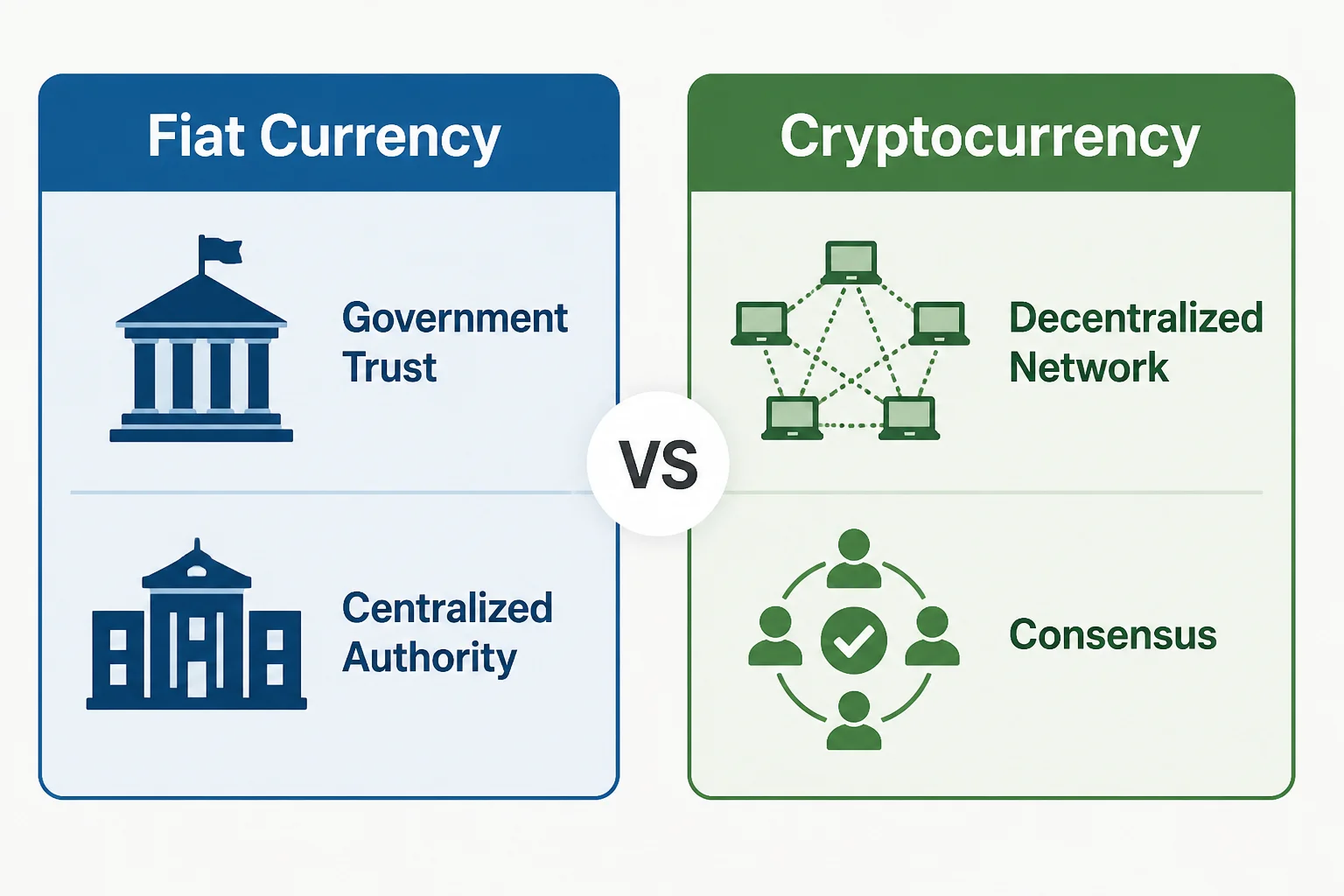
Cryptocurrency is digital money that doesn’t rely on a bank or government to keep track of who owns what. There’s no central record keeper. Instead, transactions are tracked on a blockchain, which is basically a public ledger that’s copied across thousands of computers around the world simultaneously. Because it’s distributed across so many machines, it’s extremely difficult for anyone to tamper with.
Your crypto is stored in a digital wallet. Think of it like a bank account, except you control it with a private key (a long, unique password). Here’s the catch: if you lose that private key, your crypto is gone. Forever. No customer support line to call, no “forgot my password” button. That’s a pretty unique risk compared to traditional banking, and it’s worth keeping in mind.

A few other things worth knowing about crypto:
- It’s not controlled by any government or central bank, the rules are enforced by software.
- It’s not legal tender in most countries (meaning stores don’t have to accept it).
- Transactions are recorded publicly on the blockchain, so they’re not as anonymous as people think.
- Prices are determined by supply and demand on exchanges, not by any official body.
One more thing: you’ve probably heard about stablecoins (like USDT or USDC, which are pegged to the US dollar) and CBDCs (Central Bank Digital Currencies, which are government-issued digital money). These are related concepts, but they’re not the same as decentralized cryptocurrencies like Bitcoin or Ethereum. We’re focusing on the latter in this article.
How Is Cryptocurrency Created?
Cryptocurrency is, at its core, software. Someone writes the code, sets the rules, and launches it on a network of computers. Many cryptocurrencies are open source, which means anyone can inspect the code, build on it, or fork it into something new.
The really interesting part is how new coins get released into circulation. For Bitcoin and similar currencies, that process is called mining. For others, including Ethereum since its major upgrade in 2022, it’s called staking. Let’s look at both.

Proof of Work (Mining)
With proof of work, computers on the network (called miners) compete to verify batches of transactions. To win the right to add the next block to the blockchain and earn newly created coins, a miner has to solve a fiendishly difficult math puzzle, basically guessing an enormous combination lock over and over until they get it right. The more computing power you have, the more guesses you can make per second (this is called your hash rate), and the better your odds.
It’s a clever system, but it uses a staggering amount of electricity, which is one of the biggest criticisms of Bitcoin today.

Proof of Stake (Staking)
Proof of stake is a newer approach that swaps out the energy-hungry puzzle-solving for a different system. Instead of competing with raw computing power, participants stake (lock up) some of their own crypto as collateral to get the chance to validate transactions. If they behave honestly, they earn rewards. If they try to cheat, they lose their staked coins. It’s much more energy-efficient, and it’s now how Ethereum works after its landmark “Merge” upgrade completed in 2022–2023.
The key takeaway for both methods: new coins enter circulation as rewards for the people powering the network, and those rules are baked into the software from day one.
Why Does Cryptocurrency Have Value?
This is where things get philosophical, and a little controversial. The honest answer is: it depends on who you ask.
Think about regular money for a second. The US dollar has value because the US government says it does, and everyone agrees to go along with that. It’s not backed by gold anymore. It’s backed by trust in the US economy and government. That’s called fiat currency.
Cryptocurrency is a bit different. It’s more like a commodity, something that requires effort to produce, exists in limited supply, and has value because people agree it does. Back in May 2010, someone paid 10,000 Bitcoin for two pizzas worth $40. That was the first commercial crypto transaction, and it established a baseline: two people agreed on a price, and a market was born. Those same 10,000 BTC are worth tens of millions of dollars today (the price fluctuates wildly, but you get the idea).
But here’s where the debate gets heated. Critics, including some serious economists, argue that many cryptocurrencies have no real intrinsic value: no cash flows, no legal claim on assets, and often no realistic path to widespread everyday use. Proponents fire back that Bitcoin’s capped supply of 21 million coins, its global network, and its utility as a store of value give it real worth. Both sides make fair points, and it’s worth understanding the argument rather than assuming one side is obviously right.
What Actually Makes Crypto Prices Go Up and Down?
Okay, here’s the meat of it. Crypto prices are driven by a mix of factors, some logical, some emotional, and some completely unpredictable. Here’s a breakdown of the main ones:
1. Supply and Scarcity
Bitcoin has a hard cap of 21 million coins. Once they’re all mined, no more will ever be created. On top of that, roughly every four years, the reward for mining a new block gets cut in half (this is called a halving). Less new supply coming in, combined with steady or growing demand, tends to push prices up, at least in theory.
Some other coins have burning mechanisms, where tokens are permanently destroyed to reduce supply. Others have no supply cap at all and keep issuing new coins indefinitely, which can work against the price over time.
Important caveat: scarcity alone doesn’t guarantee value. There are plenty of rare things nobody wants. Supply has to meet demand for scarcity to matter.
2. Demand: Why People Want It
This is the big one. Demand for crypto comes from several directions:
- Speculation: Most honestly, a lot of people buy crypto because they expect the price to go up. That’s not a dirty word, it’s just how markets work. But it also means prices can be driven more by hype than fundamentals.
- Institutional adoption: When major companies, investment funds, or banks start buying or holding crypto, or when spot Bitcoin ETFs launch and attract billions of dollars, that’s a massive demand signal. This has become a much bigger factor since 2022.
- Real-world utility: Some people use crypto for fast cross-border payments, decentralized finance (DeFi) applications, NFTs, gaming, and more. When a coin actually gets used for something useful, that creates organic demand.
- “Digital gold” narrative: Some investors hold Bitcoin as a hedge against inflation or currency debasement, the same reason people buy gold. Whether you buy that argument or not, enough people believe it to affect the price.
3. News, Sentiment, and Social Media
Crypto prices are famously sensitive to news. A single tweet from a high-profile figure, a regulatory announcement, or a major hack can send prices swinging by double digits in hours. That’s not an exaggeration, it genuinely happens all the time.
- Positive triggers: ETF approvals, companies announcing they’re buying Bitcoin, favorable new regulations, or major technological upgrades.
- Negative triggers: Government crackdowns, exchange collapses (remember FTX in 2022?), security breaches, or high-profile fraud.
Social media communities can also drive short-term price spikes, especially for smaller “meme coins” where coordinated buying can temporarily inflate the price before it crashes back down. Be very wary of anything that goes viral on social media as a “sure thing.”
4. Regulation
This one has become increasingly important since 2022. Regulation can cut both ways:
- Supportive regulation (like approving spot ETFs, providing clear tax rules, or formally legalizing crypto trading) tends to boost confidence and bring in new investors.
- Restrictive regulation (trading bans, lawsuits against major exchanges, or crackdowns on unregistered platforms) can quickly drain demand and tank prices.
Financial regulators around the world, including FINRA in the US and equivalent bodies in Australia, Canada, and the EU, have all issued explicit warnings that crypto is highly speculative and that you should be prepared to lose everything you invest. That’s not fearmongering; that’s the official position of major financial watchdogs in 2026.
5. Technology and Network Development
A cryptocurrency that’s actively being improved, with faster transactions, lower fees, better security, and new features, tends to attract more users and developers, which drives demand. Conversely, a network that gets hacked, suffers outages, or falls behind competitors can lose users fast.
Competition matters too. There are thousands of cryptocurrencies out there, and newer ones with better technology can pull users and investment away from older ones. This is a very real risk for any coin that isn’t constantly evolving.
6. Macroeconomic Conditions
Crypto doesn’t exist in a vacuum. When interest rates are high and investors can earn decent returns from boring, safe assets like bonds, speculative investments like crypto tend to be less attractive. When rates are low and investors are chasing returns, crypto benefits. The broader “risk on / risk off” mood of global markets has a real effect on crypto prices, something that became very obvious during the 2022 crypto winter, when rising interest rates helped trigger a massive market collapse.
How to Evaluate Any Cryptocurrency
Whether you’re curious about a coin you’ve heard about or doing your own research before making any financial decisions, here’s a practical framework for thinking through a cryptocurrency’s value potential. (And remember: this is for educational purposes, always consult a financial advisor before investing anything.)
Step 1: Understand What It’s Actually For
What problem does this coin solve? Is it meant for payments, powering a specific platform, governance voting, or something else? Does real usage exist today, or is it mostly promises and a whitepaper? If you can’t easily answer what it does, that’s a red flag.
Step 2: Look at the Supply and Tokenomics
Tokenomics is just a fancy word for the economics of a token: how many exist, how many more will be created, and who owns them. Check the total and circulating supply, the issuance schedule, and whether a large chunk of coins is held by the founding team (which can mean they’ll dump their holdings on the market later).
Step 3: Check Adoption and Real Activity
How many people are actually using it? Look at transaction volumes, the number of active developers building on the network, and whether real businesses or applications are integrating it. Tools like CoinGecko, CoinMarketCap, and on-chain analytics platforms like Glassnode or Dune Analytics can help you dig into this data.
Step 4: Assess Liquidity and Market Structure
Liquidity means how easily you can buy or sell without moving the price significantly. A coin with very low trading volume might look attractive on paper but could be nearly impossible to sell at a fair price when you want out. Stick to coins listed on reputable, high-volume exchanges.
Step 5: Evaluate the Risks
Is the coin likely to be classified as a security by regulators (which could restrict who can trade it)? Has there been a history of hacks, “rug pulls” (where developers abandon the project and take the money), or smart contract exploits? Who controls the ability to make changes to the protocol? These questions matter a lot.
Step 6: Be Honest About Your Risk Tolerance
Major financial regulators are unambiguous: crypto is highly speculative, and you can lose all of your money. If you’re thinking about investing, only use money you could afford to lose entirely, and consider it a small part of a diversified portfolio, not a retirement plan.
Common Questions About Crypto Value
Why Is Crypto So Volatile?
Compared to stocks or bonds, the crypto market is relatively small and thinly traded. That means large holders (called whales) moving big amounts of crypto can swing prices significantly. Add in heavy use of leveraged derivatives (essentially borrowed money bets), rapid sentiment shifts driven by social media, and a market that trades 24/7 with no circuit breakers, and you’ve got a recipe for dramatic swings. Double-digit daily moves are not unusual, and that goes in both directions.
Does Crypto Have “Real” Value or Is It Just a Bubble?
Honestly? There’s no consensus, and anyone who tells you they know for certain is oversimplifying. Critics point out that most cryptocurrencies have no cash flows, no backing, and no guarantee of future utility. Supporters argue that Bitcoin’s scarcity, network effects, and growing institutional adoption give it genuine value. For many smaller coins, the fundamentals are weak and the price is driven almost entirely by speculation. It’s worth approaching each coin on its own merits rather than assuming the whole asset class is either worthless or revolutionary.
Can I Lose Everything?
Yes. And not just from price crashes. You can also lose access to your crypto by losing your private key, fall victim to scams (pump-and-dump schemes, fake giveaways, phishing attacks, and rug pulls are all widespread), or get caught up in an exchange collapse. FINRA, Australia’s MoneySmart, Canada’s CIRO, and other major regulators all explicitly state that crypto investors should be prepared to lose their entire investment. That’s not hypothetical, plenty of people have.
Tips and Troubleshooting
Watch Out For These Red Flags
- Guaranteed returns: No investment guarantees returns, and anyone promising them in crypto is almost certainly running a scam.
- Celebrity endorsements: These are frequently fake or paid promotions. Do your own research.
- “Get in before it’s too late” pressure: Urgency is a classic manipulation tactic. Legitimate investments don’t disappear in 24 hours.
- Anonymous teams: If you can’t find out who’s building a project, that’s a significant red flag.
- Extremely high yields in DeFi: If a platform is offering 200% annual returns, ask yourself where that money is actually coming from.
Useful Tools for Research
- CoinGecko / CoinMarketCap: Market cap, trading volume, circulating supply, price history for thousands of coins.
- Messari: More detailed research and analysis, especially useful for understanding tokenomics.
- Glassnode / CryptoQuant / Dune Analytics: On-chain data showing actual network activity, useful for separating hype from real usage.
- FINRA’s crypto resources: Official risk information from a US financial regulator, worth reading before putting any money in.
Protect Your Crypto
- Use a hardware wallet for any significant amount of crypto, it keeps your private key offline and away from hackers.
- Never share your private key or seed phrase with anyone, ever. No legitimate service will ask for it.
- Enable two-factor authentication on any exchange account you use.
- Be skeptical of unsolicited messages about crypto opportunities, even from people you know (their accounts may be compromised).
Wrapping Up
Cryptocurrency gains value the same way most things do: supply, demand, and what people believe it’s worth. The difference is that crypto markets are younger, less regulated, and far more volatile than traditional financial markets, which means the swings can be exhilarating on the way up and absolutely brutal on the way down (as anyone who lived through 2022 can tell you). The core drivers, including scarcity, utility, adoption, regulation, and sentiment, are all real, but for many coins, speculation still dominates everything else.
If you’re thinking about getting involved, go in with eyes open: understand what you’re buying, only risk what you can afford to lose, and treat any “guaranteed” opportunity with maximum skepticism. The technology is genuinely interesting, and the space has matured a lot since the early days, but that doesn’t mean the risks have gone away. Do your homework, and you’ll at least be making informed decisions rather than just hoping for the best.