
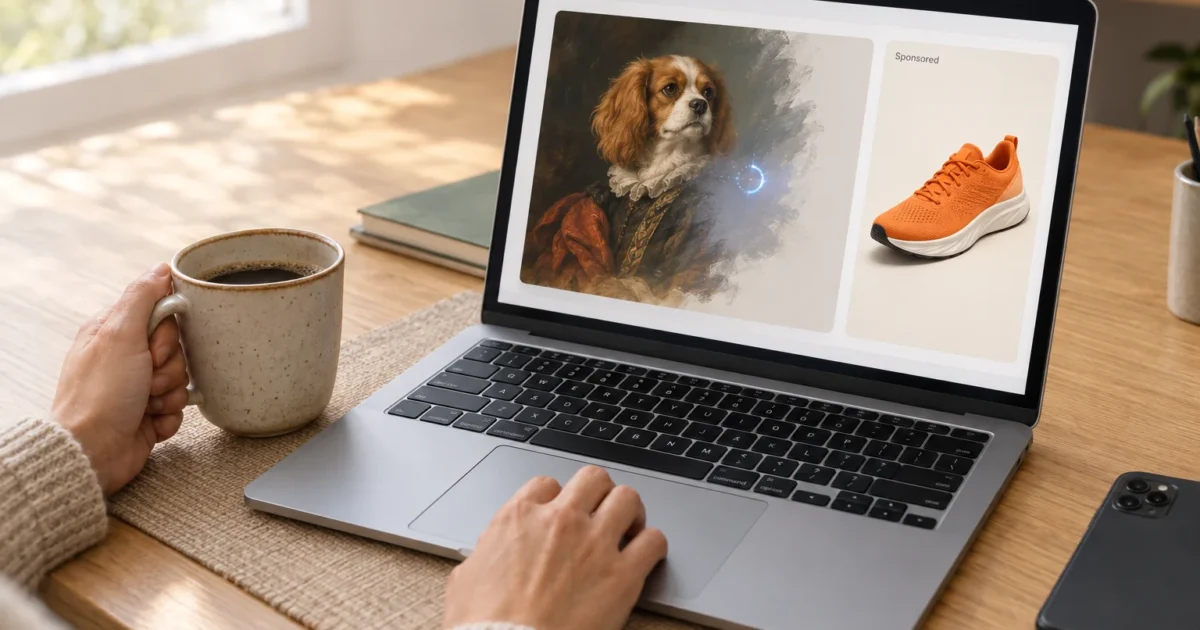
On October 5, 2026, OpenAI announced that it will test a new visual ad format for ChatGPT Ads inside ChatGPT’s image-generation feature. The ads are image-based, and they appear while ChatGPT is creating a picture for you. OpenAI also announced a large batch of new measurement and tracking partners for advertisers. Testing starts later in October 2026. It covers only the United States and only a limited first group of advertisers.
So, will you see a product photo pop up the next time you ask ChatGPT to draw your dog as a Renaissance painting? Probably not yet. This is a small, early test, not a global launch. Below, we separate what OpenAI has actually confirmed from what’s still just a promise. That way you won’t overestimate how ready (or how proven) this feature is.
What Happened: The ChatGPT Ads New Format, Explained
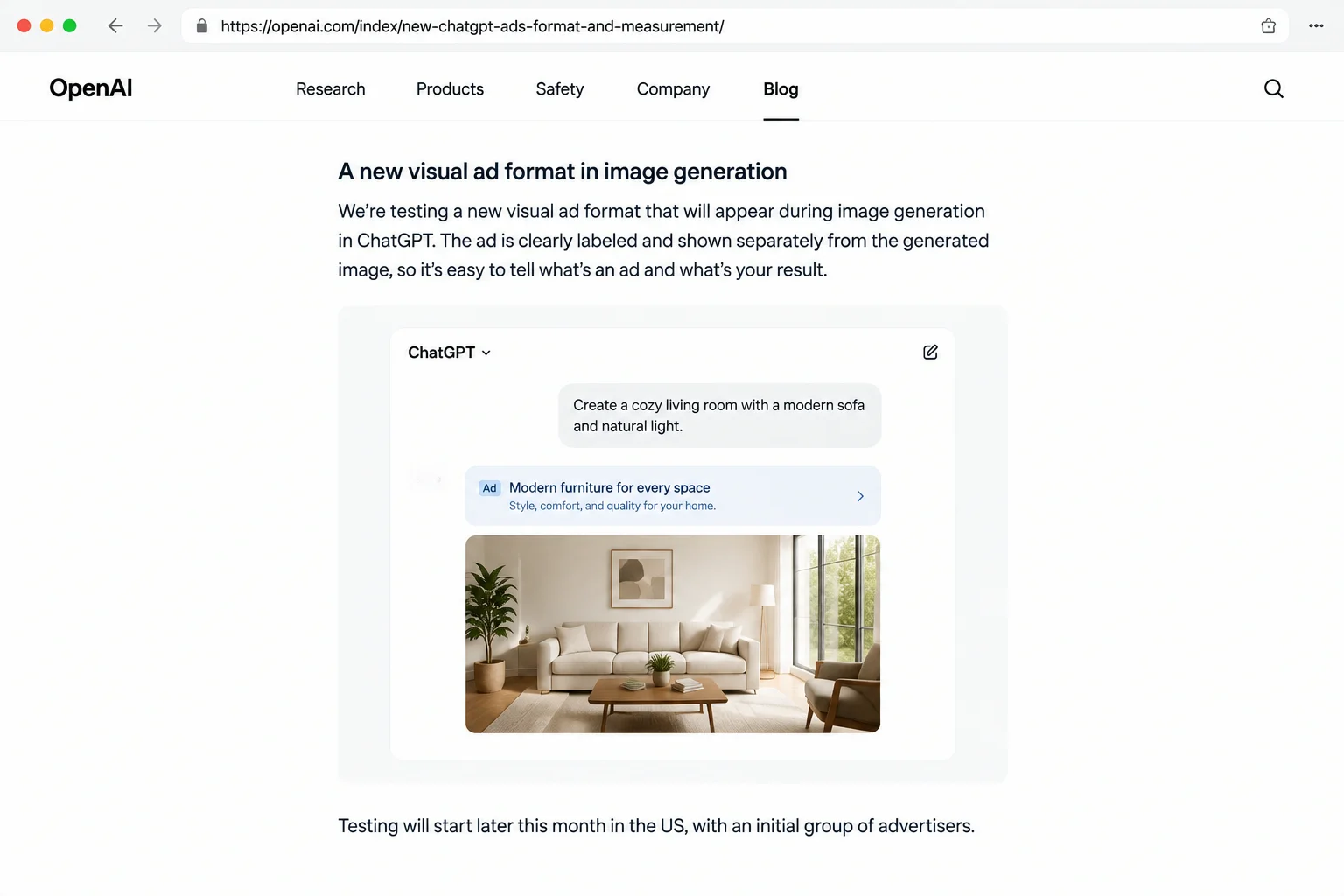
Until now, ChatGPT ads have mostly been text-based. The new format is visual. According to OpenAI’s announcement (retrieved October 5, 2026), these ads show up while ChatGPT is generating an image for you. A typical ad might be a product photo or a brand’s idea offered as “inspiration” next to the picture ChatGPT is making.
Think of it like the display rack next to a paint counter. You came in for a specific color, and the store shows you a finished room that uses it. The rack isn’t your paint, but it sits right beside it.
OpenAI’s Stated Safeguards
OpenAI made three promises about how the new ads will behave:
- Clear labeling: Ads will be clearly marked as advertising.
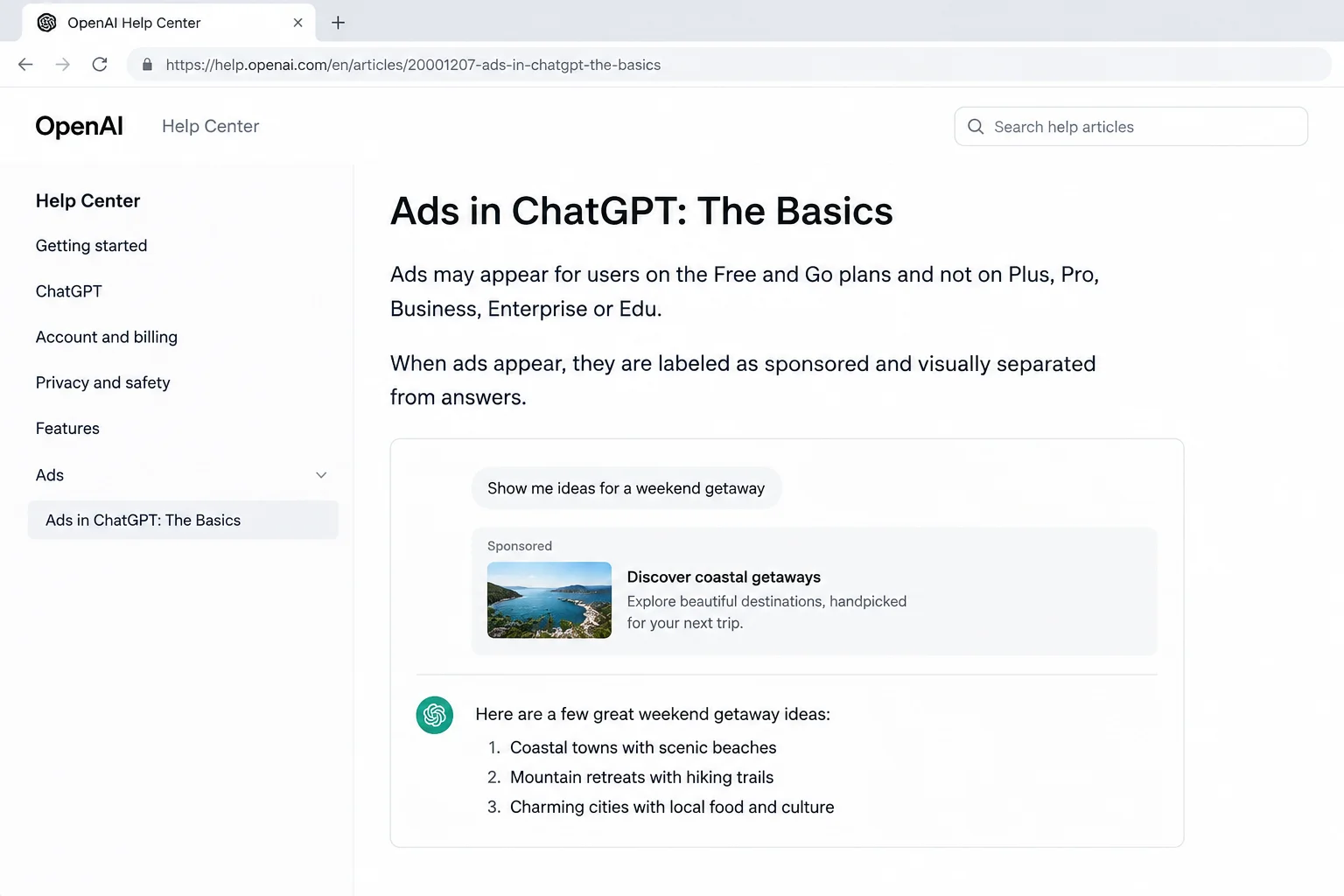
- Visual separation: Ads will be kept visually apart from the image ChatGPT generates for you, so the two shouldn’t blur together.
- No influence on answers: OpenAI says ads won’t change or bias ChatGPT’s actual responses.
The first two are design choices you’ll be able to check for yourself once the format reaches your account. The third is a company policy statement. None of the sources we reviewed independently verified it. That doesn’t make it false. It just means you’re relying on OpenAI’s word for now.
If you want the general ground rules for how ads already work in ChatGPT, OpenAI’s Help Center has a basics page. It’s worth a skim.
The New Measurement Tools (in Plain English)
The second half of the announcement is aimed squarely at businesses. Advertisers want concrete proof that an ad led to a sale. OpenAI is adding several kinds of tracking tools, according to its announcement:
- Customer-data connections: Hightouch, Tealium, and LiveRamp. These let a business send its own sales data into ChatGPT Ads, so it doesn’t have to rebuild tracking from scratch.
- Attribution partners: AppsFlyer, Triple Whale, Adjust, DV Rockerbox, Northbeam, Branch, Singular, Kochava, Airbridge, and Tenjin. Attribution just means figuring out which ad deserves credit for a click, app install, or purchase.
- Full-funnel reporting: Fospha, Measured, and INCRMNTAL. These track a customer’s whole path from first seeing an ad to buying something.
- Incrementality tests: Haus, Measured, and WorkMagic are running early location-based experiments. Incrementality asks a blunt question: did the ad actually cause the sale, or would that person have bought it anyway?
Brand-Suitability Pilots
OpenAI is also piloting brand-suitability tools with DoubleVerify and Integral Ad Science (IAS). These services help advertisers avoid placements that clash with their brand. A children’s toy company, for example, doesn’t want its ad sitting next to something edgy. OpenAI says these pilots aren’t designed to expose anyone’s private conversations.
The key word is pilots. These are early tests, not a finished, independently audited system.
Who This Affects
- Everyday ChatGPT users in the U.S.: You might start seeing labeled image ads during image generation once testing begins later in October, but only on an ad-eligible plan. OpenAI’s ads basics page says ads can appear on the Free and Go plans, not on Plus, Pro, Business, Enterprise, or Edu accounts, and not for accounts identified as belonging to users under 18. Most eligible people won’t see the new format right away.
- Users outside the U.S.: This specific test is U.S.-only for now.
- Small businesses and marketers: This is where the real news is. The new measurement tools make ChatGPT Ads easier to evaluate, but the platform is still young.
- Big brands: The DoubleVerify and IAS pilots are OpenAI’s early answer to brand-safety worries. They don’t settle those worries yet.
The Details
| Item | What OpenAI Says | Source |
|---|---|---|
| Announcement date | October 5, 2026 | OpenAI |
| Where ads appear | During ChatGPT image generation | OpenAI |
| Test start | Later in October 2026 | OpenAI |
| Region | United States only | OpenAI |
| Who can run them | Initial group of advertisers | OpenAI |
| Ads Manager status | Still in beta | OpenAI FAQ |
| Cross-advertiser benchmarks | Not available yet | OpenAI FAQ |
| Pricing for the new format | Not disclosed | N/A |
For background, OpenAI expanded how businesses can buy ChatGPT ads back in May 2026. That earlier update is covered in its new ways to buy ChatGPT Ads post.
About Those Performance Numbers
OpenAI’s announcement points to partner case studies. For example, DV Rockerbox reported a cost per acquisition 15.3% below a paid-search benchmark for WeightWatchers, and WorkMagic reported 2.3x more incremental orders for Dose than last-click attribution captured (PPC Land’s breakdown). The announcement doesn’t give spend, campaign dates, or sample sizes for those results. Sounds great, right?
Here’s the catch. OpenAI’s own FAQ says ChatGPT Ads is still in beta and doesn’t yet have performance benchmarks across advertisers, industries, or campaign types. So those case-study numbers are selected examples from partners, not cross-advertiser benchmarks. Without more detail, there’s no way to tell how typical they are. Treat them like the “after” photo in a fitness ad: real for someone, not a promise for you.
How It Stacks Up
How does ChatGPT Ads compare with the ad platforms small businesses already use? We don’t have comparable published performance numbers for this new format. That’s the whole point, since OpenAI says no benchmarks exist yet. So this comparison is about maturity, not results.
| Platform | Ad Format Context | Track Record | Independent Benchmarks |
|---|---|---|---|
| ChatGPT Ads (new visual format) | Labeled image ads during AI image generation | Beta; U.S. test starting later in October 2026 | None yet, per OpenAI’s FAQ |
| Google Ads | Search, display, and Performance Max | Long-running, with mature built-in reporting | Third-party industry benchmark reports exist |
| Meta Ads (Facebook/Instagram) | Social feed and story ads | Long-running, with built-in attribution tools | Third-party industry benchmark reports exist |
| Microsoft Advertising (Bing) | Search, including AI-assisted search | Long-running | No direct comparison to this format |
The takeaway is simple. Google and Meta are the well-worn highway. ChatGPT Ads is a newly paved road with a few promising signs and no traffic data yet. The new measurement partners matter because many of them are names marketers already use elsewhere. That makes it easier to compare ChatGPT results against your existing campaigns, using the same tools for both.
The Reaction
Reaction is still forming. Early social media chatter splits along the same line this article draws. Some posts cheer the ad business’s reported growth and new advertiser features. Others worry about ads blending into conversations, low-quality or bot-like traffic, and ChatGPT slowly getting more cluttered. None of those claims are verified, in either direction.
That split is the story. Excitement comes from claims that aren’t independently confirmed. Concern comes from questions OpenAI hasn’t fully answered yet.
What to Do Next
If you’re an everyday user: Nothing to do. Just know that if you see a product image appear while ChatGPT is generating a picture, it should carry an ad label and sit apart from your image. OpenAI says you can dismiss ads and give feedback on them, so if you can’t tell what’s an ad, use that feedback option.
If you’re a small business or marketer: Read OpenAI’s ChatGPT Ads FAQ before spending anything. If you do test it, start small and measure with an attribution tool you already trust. Also remember the format is visual. A clean product photo matters, and a simple lightbox or ring light plus a smartphone tripod can go a long way.
Our Take
Who should care right now: Marketers and small business owners who already advertise online and like testing new channels. The new measurement partners are a real step forward. They make ChatGPT Ads measurable with familiar tools instead of a black box.
Who can mostly ignore it for now: Everyday ChatGPT users. This is a limited U.S. test with a small group of advertisers. Awareness is enough. Know what an ad should look like, and be skeptical of anything that blurs the line.
What we’d hold off on: Treating partner case-study numbers as typical, or assuming brand safety is solved. OpenAI itself says there are no benchmarks yet, and the DoubleVerify and IAS work is explicitly a pilot. The “no influence on answers” promise is good to hear, but it’s still a policy statement, not an independently tested fact.
Our verdict: this is a smart, careful-looking start from OpenAI. It’s also a start. Don’t move your whole ad budget over because of a few glowing case studies.
Your Questions, Answered
- Will I see ads in ChatGPT soon? Only if you’re in the U.S., on an ad-eligible plan (Free or Go), and happen to be included in the limited test that starts later in October 2026.
- How will I know it’s an ad? OpenAI says the ads will be clearly labeled and kept visually separate from your generated image.
- Are ChatGPT’s answers now influenced by advertisers? OpenAI says no. That’s the company’s stated policy, and our sources didn’t independently verify it.
- Is this good for businesses? It’s promising for measurement, but the platform is still in beta and unproven at scale.
- Can I trust the performance numbers? Treat them as partner-reported examples, not benchmarks.
Wrapping Up
OpenAI is putting ads where people are already looking at pictures. For now, it’s a small U.S. test, so watch for the ad label, and if you advertise, test small and let your own data decide.
| Who | What to Do | Applies To |
|---|---|---|
| Everyday ChatGPT users | Watch for labeled image ads during image generation | U.S. users in the test |
| Small businesses | Read the FAQ, then test with a small budget | ChatGPT Ads beta advertisers |
| Marketers | Connect a familiar attribution or customer-data tool | Initial advertiser group |
| Brand-safety teams | Follow the DoubleVerify and IAS pilots before relying on them | Advertisers with strict brand rules |